

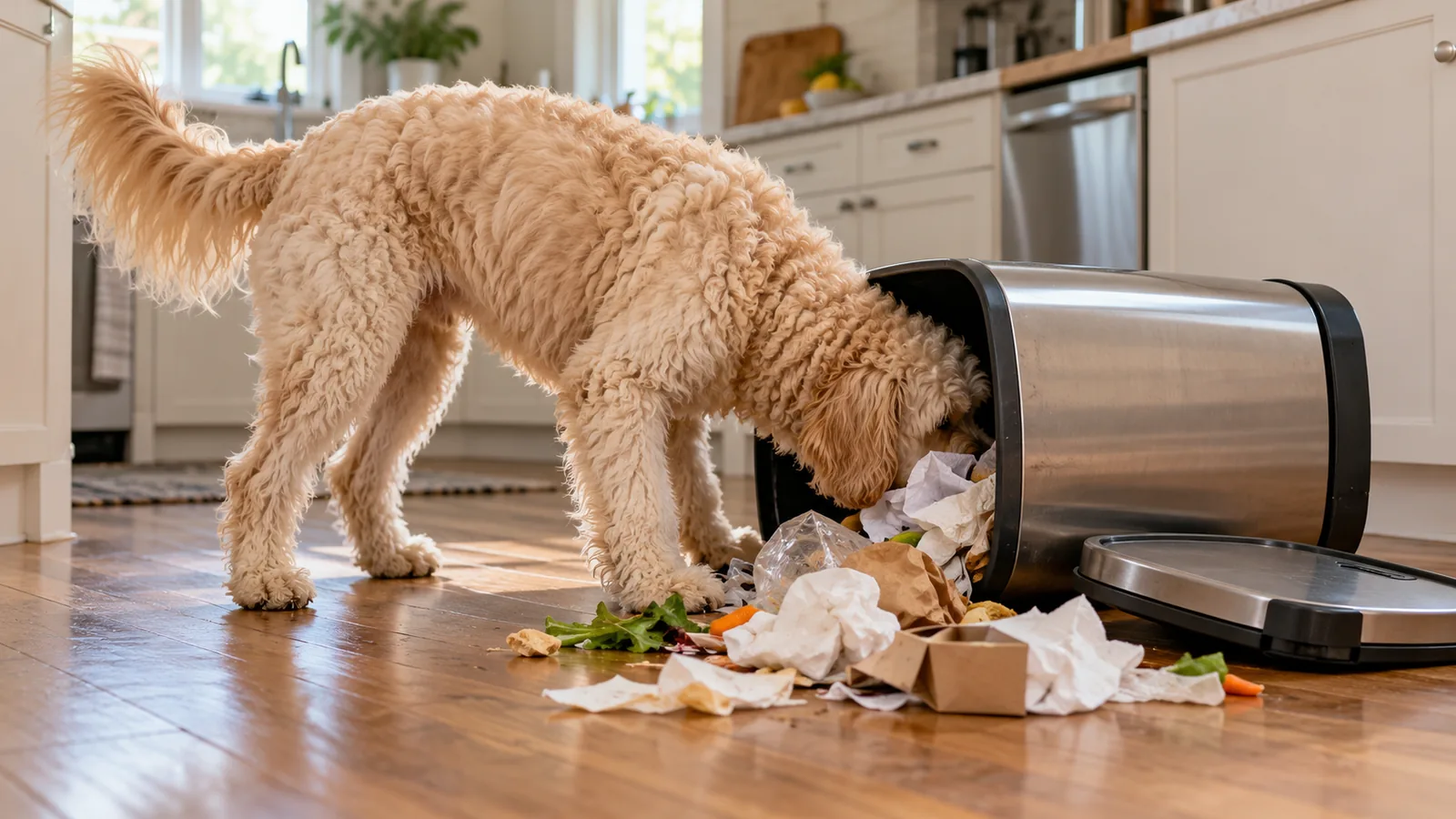
Whether a swallowed object passes on its own, comes back up, or needs to be removed surgically depends on what it is, where it sits now, and how long it has been there. Size and shape matter, and string, thread, tinsel, and fabric carry the highest risk because they can saw through the intestinal wall instead of moving along it. Once something blocks the intestine, blood flow to that stretch of gut starts to fail, and a pet who seemed fine a few hours earlier can go downhill quickly. The question worth settling is not whether the object will pass, but how quickly you can find out.
El Paso Animal Hospital in Derby sees these cases regularly, and digital X-rays are the first thing we reach for to see whether a foreign body is sitting in the stomach or lodged further down the intestine. Caught early, while the object is in the stomach, some pets can bring it back up with medication we give here, though that is the wrong move for string, ribbon, and anything sharp, which cause more damage on the way out. Once something has reached the intestine, abdominal surgery is how it comes out, and we can often operate immediately, so call us right away if you think your pet swallowed something, or go straight to the nearest 24-hour emergency hospital when we are closed.
Swallowed Objects: What to Know First
- Linear objects like string, ribbon, tinsel, and dental floss are the worst case, because one end anchors while the intestine keeps pulling the rest through.
- Most pets act normal at first, so watch how fast the signs pile up: repeat vomiting, a refused meal, and a pet who can't settle, all in one afternoon.
- Don't make your pet vomit at home unless we've told you to, and never pull on a string hanging from the mouth or the rear.
- An object still in the stomach leaves far more options than one that's moved into the intestine.
What Are the Early Signs of a Blockage?
The early signs of a blockage are vomiting that repeats within a few hours, vomit that brings up food eaten long ago, and a pet who won't settle. Not every episode of vomiting means something is stuck, since a dietary upset or pancreatitis can look much the same at first, but that combination means calling us now rather than in the morning.
Puppies and kittens turn up most often, since chewing is how they investigate a new house and a small intestine doesn't need a large object to plug it. We walk new families through the household items most likely to get swallowed during puppy and kitten care visits. Cats are quieter: one who's gotten into a spool of thread may do nothing but hide, skip a meal or two, and vomit once before anybody suspects anything.
Which Early Signs Mean You Should Call Us Today?
One episode of vomiting is worth watching. Vomiting plus a refused meal plus a hunched, restless pet in one afternoon is a pet emergency, not a wait-until-morning problem.
- Repeat vomiting or dry heaving: food, water, or nothing at all coming back up.
- Appetite gone: a pet who turns down a favorite treat.
- Straining with nothing to show for it: passing only mucus or a little liquid.
- Restlessness: pacing, or lying down and standing right back up.
- The praying posture: chest on the floor, rear in the air, how dogs and cats hold a painful belly.
- A tense or swollen abdomen: flinching, turning, or snapping when you reach for the belly.
- Low energy: quiet, uninterested in the door, the leash, or the food bowl.
Walk-ins are welcome for emergency and urgent care during our open hours, and a call on the way helps us be ready when you arrive.
Why Do Some Blockages Look Milder Than They Are?
A gastrointestinal foreign body obstruction can be complete, partial, or linear, and the three look very different from the outside.
| Type | What's happening inside | What you may notice |
| Complete | Nothing gets past the object | Vomiting that won't quit, no stool, a pet sliding downhill over hours |
| Partial | Liquid and gas squeeze past a smaller object | On-and-off vomiting and loose stool for days, an appetite that comes and goes |
| Linear | One end caught under the tongue or at the stomach outlet, the rest traveling on | Vomiting, drooling, belly pain, sometimes thread visible under the tongue |
Partial obstructions are the ones that slip by, because a pet who eats a little and keeps some of it down looks like a mild stomach upset, so vomiting that keeps coming back over several days needs imaging even if your pet seems comfortable in between. If you can see thread or ribbon under the tongue or hanging from the rear, leave it alone: pulling drags the anchored end through tissue that's already compromised.
Why Can't a Blockage Wait Until Tomorrow?
A blockage can't wait because pressure from the lodged object cuts off circulation to that stretch of intestine, and tissue without blood supply begins to die within hours. Bacteria and gut contents then leak into the abdomen, which turns a fixable problem into sepsis, a body-wide infection. An object found early often comes out through one small opening in healthy intestine, while that same sock found two days later may sit in a segment that has to be removed entirely.
- Objects that lodge instead of passing: Corn cobs, socks, hair ties, chunks of rawhide, peach pits, and cooked bones are the hazardous household items we take out most often.
- Batteries, coins, and magnets: A button battery can burn through tissue quickly, coins exposed to stomach acid can turn into heavy metal poisoning, and two magnets swallowed separately can pinch a loop of bowel between them.
- Anything that may be poisonous: For a medication, a nicotine pouch, or anything else toxic rather than simply stuck, call us or the Pet Poison Helpline right away.
How Do We Tell If Something Is Really Stuck?
We start with a hands-on exam, because a loop of bunched intestine can sometimes be felt through the belly wall, and we lift the tongue, because a linear object anchored at its base changes the whole plan. Then come X-rays to read gas patterns and find anything dense enough to show up, plus bloodwork for hydration, electrolytes, and signs of infection. We can run both here in Derby during an urgent visit, and a pet who's dehydrated or painful gets fluids started before anything else.
Metal, bone, and stone show up clearly, while cloth, string, rubber, and many plastics are close to invisible. What we read instead is the pattern: loops of intestine stretched wide with gas, or one side of the bowel distended while the other is flat. Repeating the X-rays a few hours apart tells us whether anything is moving. A barium study or abdominal ultrasound is for a pet whose X-rays are clean while the story still doesn't add up, and it sometimes keeps them out of surgery.
What Are the Options Once We Know Something Is Stuck?
The options run from monitoring with fluids and repeat X-rays, to bringing the object back up with medication, to retrieving it through the mouth with an endoscope, to abdominal surgery. Which one fits depends on where the object is sitting, what it's made of, and how your pet is doing, and we'll go over the plan with you before anything starts.
When Can a Swallowed Object Be Handled Without Surgery?
An object still sitting in the stomach that's smooth, small enough to pass safely, and swallowed within the last couple of hours may come back up by vomiting with medication we give here. That window is narrow, and it closes the moment the object moves into the intestines.
Never try to make your pet vomit at home unless we've told you to. Hydrogen peroxide causes its own damage: ulcers in the stomach lining, and a real risk of aspiration into the lungs. Never induce vomiting for anything sharp, or for string, ribbon, or thread, which tear more coming back up the esophagus than they did going down. For a small, smooth item that's already cleared the stomach, the plan is sometimes fluids, a recheck, and repeat X-rays to confirm it's traveling, and surgery comes back into the conversation if vomiting starts or the object stalls between one set of images and the next.
How Does Endoscopic Removal Work?
A camera on a flexible tube goes down the throat with grasping tools alongside it. Veterinary endoscopy retrieves an object from the esophagus or stomach through the mouth with no abdominal incision, which usually means a shorter time under anesthesia and a pet often eating normally again within a day. Fishhooks, coins, rocks, and wads of fabric still in the stomach are the usual candidates, while anything too large to come back up the esophagus, and anything that's already traveled downstream, needs the abdominal route. Once we've seen the images, we'll let you know whether retrieval can happen at our hospital or is better done at a hospital set up for it.
What Happens During Foreign Body Surgery?
Obstruction surgery means opening the belly, locating the object, and taking it out through either the stomach wall or the intestinal wall, depending on where it stopped.
- Gastrotomy: Opening the stomach, the most forgiving version, since stomach tissue heals well.
- Enterotomy: Opening the intestine directly over the object and closing it again.
- Resection and anastomosis: The one we hope to avoid. When a segment has already lost its circulation, that piece comes out and the two healthy ends are sewn back together.
Your pet stays on continuous monitoring and IV fluids before, during, and after, with pain medication plans tailored to their situation.
What Does Recovery Look Like Before Your Pet Comes Home?
The first day is about fluids, pain control, and watching for vomiting. Repaired intestine needs a few days to seal, so food goes back in as small, bland portions once water stays down. Pets go home once they're comfortable, keeping water down, and interested in food. Some pets can go home the same day; others, especially those who needed a section of intestine removed, may be transferred for overnight care to a local ER.
| Window | What we're watching | What progress looks like |
| First 24 hours | Vomiting, pain scores, blood pressure, urine output | Water staying down, resting comfortably, standing to greet you |
| Days 2 to 3 | Appetite, first bowel movement, incision swelling | Small bland meals holding, brighter and more curious |
| Days 4 to 7 | Incision edges, energy, stool consistency | Normal stool, normal hunger, no redness or discharge |
| Days 10 to 14 | Suture removal, full healing | Back on regular food, cleared for usual activity |
Call us the day something in that table looks off, rather than saving it for the recheck.
What Complications Should You Watch For After Surgery?
The complication that matters most is a leak where the intestine was closed, and the warning sign is a pet who was improving and then stops: vomiting returns, a fever climbs, and they get quiet and weak. That reversal typically happens in the first three to five days, and a leak caught on day three can often be repaired, while the same leak on day five is a far sicker patient.
- Incision changes: redness, swelling, discharge, a gap in the closure, or a pet who has gotten the e-collar off.
- Vomiting that comes back: especially after a day or two of eating normally.
- Fever or fresh lethargy: a pet who brightened up and then went flat.
- No stool by day three, or diarrhea with blood in it: either direction needs a phone call.
- Pain that isn't controlled: panting, trembling, or refusing to lie down.
The veterinarian who performed the surgery knows exactly what your pet's intestine looked like that morning, so a recheck here in Derby beats guessing over the phone.
How Do You Care for Your Pet at Home During Recovery?
Home recovery comes down to four things: keeping your pet quiet for roughly two weeks, keeping the e-collar on, feeding small bland meals spread through the day, and looking at the incision twice daily. The restriction matters most, since one hard landing off the back of the couch can strain a closure that's still healing.
- Enrichment instead of exercise: Ten minutes of nose work or a food puzzle can tire a dog out as well as a walk, so dog enrichment activities help during two weeks of leash-only restriction. Cats need the same outlet without the jumping, and cat enrichment toys made from a cardboard box or a paper bag keep them at floor level.
- Confinement: Crate rest goes better when the crate sits where the family spends the evening and meals get fed inside it.
- Incision checks: Morning and night in good light, looking for a clean, dry line with the edges meeting. No baths, no sprinklers, no damp towels: water gets into gaps that haven't finished sealing.
- Supervision: Leash walks only, so you can see what goes into your dog's mouth. For cats, a few days of closed doors instead of launching onto the top of the bookshelf.
How Can You Keep This From Happening Again?
Pets who've done this once often try again, and many go back to the same few spots, so pet-proofing your home means lidded trash cans, a latched laundry hamper, and small toys stored above nose level.
- Chew choices: Pick chews too big to fit entirely in your dog's mouth, and retire anything whittled down to a swallowable chunk. Rawhide and real bones break into pieces that lodge.
- Training: "Leave it" and "drop it" are the two cues worth teaching early. Trade for something better than whatever got picked up.
- Cats and string: Thread, dental floss, ribbon, hair ties, and tinsel belong behind a closed drawer. A cat's tongue has backward-facing barbs, so once thread is in the mouth, swallowing is easier than spitting it out.
- Scavengers on walks: For a dog who picks up something on every walk, basket muzzle training done slowly with treats passed through the front turns the muzzle into something good. They can still pant, drink, and sniff through it.
- Planning ahead: Obstruction surgery with a hospital stay is one of the more expensive events in a pet's life, and one of the most common surgeries we do. Pet insurance typically covers it only when the policy is in place before your pet has a documented history of eating things.
We can go through those spots with you at your next preventive care visit, especially for a pet who's already been through one removal.
What Families Ask Us After a Pet Swallows Something
How long does it take a swallowed object to pass?
A small, smooth item that clears the stomach usually turns up in the stool within one to three days, though that isn't a reason to wait and watch. Objects that stall in the stomach can sit there for weeks without causing a single sign, and the ones that stall in the intestine do damage while you're still counting days.
My dog ate a sock and seems completely fine. Do we still need to come in?
A sock needs a visit even from a dog who's bouncing around the kitchen. Fabric is close to invisible on an X-ray and socks are one of the classic obstructions we remove, so come in while the sock may still be in the stomach, where it can often be brought back up instead of cut out.
Will my pet eat normally again after intestinal surgery?
Most pets go back to their regular diet. The first several days are small, bland, frequent meals while the repair seals, then food returns to normal over a week or two. Pets who needed a long segment of intestine removed can be left with a lasting need for a specific diet, though that's uncommon. We'll go over your pet's diet plan with you before they go home.
When You're Not Sure What Your Pet Swallowed
If something's missing from the laundry basket and your dog seems a little off, El Paso Animal Hospital in Derby offers walk-in urgent care for pets who may have swallowed something. Call us in Derby the moment you suspect it, even if you aren't sure it's an emergency, and we'll start with the exam and the images that show us how serious the problem is.



Leave A Comment